
School Desk and Chair Height by Age
A desk that is too high pushes shoulders up; a chair that is too low leaves knees higher than hips. Children shift, slump and lose focus. The fix is simple: match the desk and chair to each other and to the child’s height. This guide gives the matching desk and chair heights by age, shows how to check the fit in a real classroom, and explains how to plan sizes for a whole school.
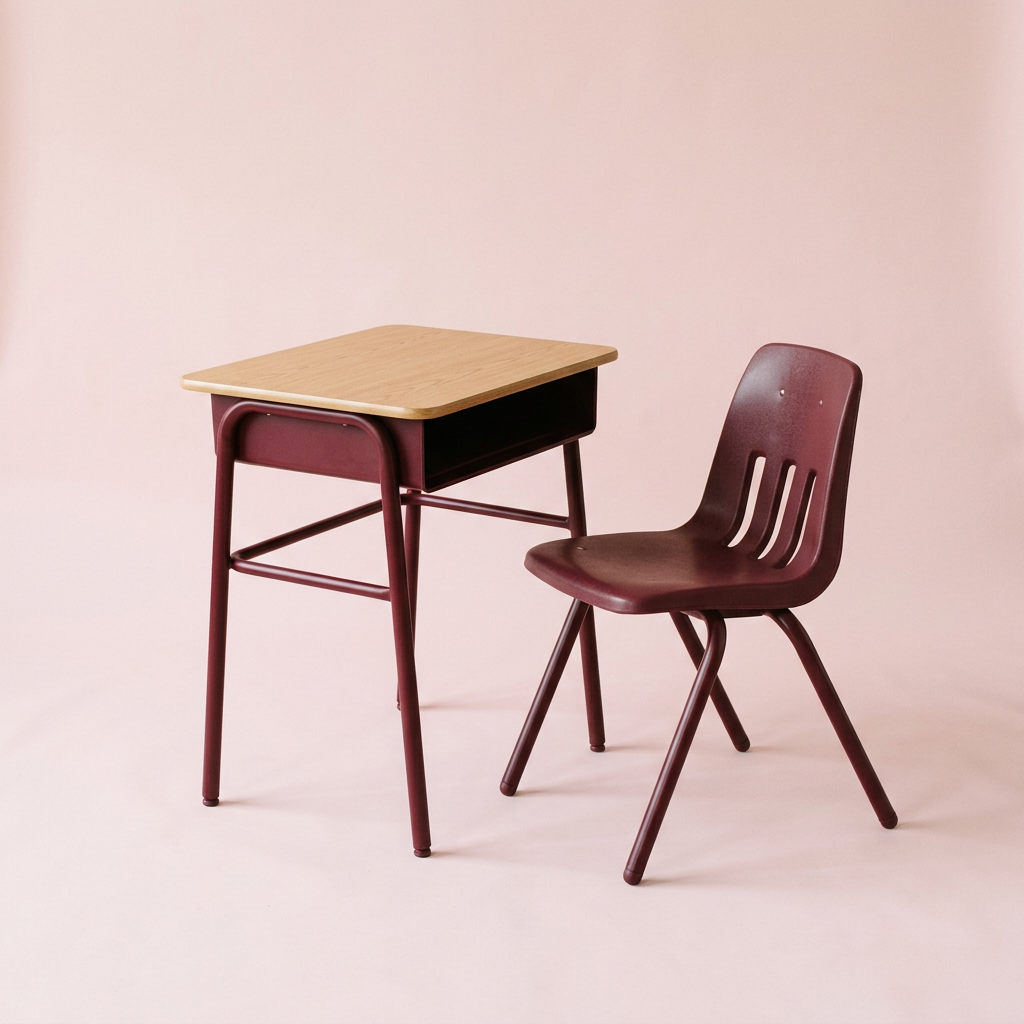
Desk and Chair Height Chart (EN 1729)
Quick answer: Under EN 1729, desk and chair heights rise together with the child’s height, from a 400 mm desk and 210 mm seat for toddlers to a 760 mm desk and 460 mm seat for secondary students. Always choose by height, not only by age, and keep the desk and chair in the same size mark.
Try the calculator: enter a child’s height, age or UAE school grade in our school desk and chair height calculator to get the right size, seat height and desk height straight away.
| Size mark | Colour | Child’s height | Seat height | Desk height | Typical age |
|---|---|---|---|---|---|
| 0 | White | 80–95 cm | 210 mm | 400 mm | 2–3 |
| 1 | Orange | 93–116 cm | 260 mm | 460 mm | 3–4 |
| 2 | Violet | 108–121 cm | 310 mm | 530 mm | 4–5 |
| 3 | Yellow | 119–142 cm | 350 mm | 590 mm | 6–7 |
| 4 | Red | 133–159 cm | 380 mm | 640 mm | 8–10 |
| 5 | Green | 146–176.5 cm | 430 mm | 710 mm | 11–13 |
| 6 | Blue | 159–188 cm | 460 mm | 760 mm | 14–18 |
| 7 | Brown | 174–207 cm | 510 mm | 820 mm | Adults |
Ages are a rough guide only. Children in the same class can span two size marks, which is why the height column matters most. The colour code is often marked on the furniture so staff can check at a glance that desk and chair match.
Desk Height by Age: Quick Lookup
| Age | Usual size mark | Desk height | Chair seat height |
|---|---|---|---|
| 2–3 | 0 | 400 mm | 210 mm |
| 3–4 | 1 | 460 mm | 260 mm |
| 4–5 | 2 | 530 mm | 310 mm |
| 6–7 | 3 | 590 mm | 350 mm |
| 8–10 | 4 | 640 mm | 380 mm |
| 11–13 | 5 | 710 mm | 430 mm |
| 14–18 | 6 | 760 mm | 460 mm |
What desk height for a 10-year-old? Most 10-year-olds fit size mark 4: a 640 mm desk with a 380 mm seat. A tall 10-year-old, over about 146 cm, may be better in size 5: a 710 mm desk with a 430 mm seat. Use the fit check below to decide.
Is there one standard school table height? No. EN 1729 sets eight sizes from 400 mm to 820 mm. Most primary classrooms use 590 to 640 mm desks and most secondary classrooms 710 to 760 mm.
Ages 6 to 10 and safety. EN 1729-1 sets the sizes, and sizes 3 and 4 cover most children aged 6 to 10. EN 1729-2 sets the strength, stability and safety tests for the furniture itself. When buying, ask which parts of EN 1729 the furniture has been tested to.
How to Check the Fit in a Classroom
You do not need to measure every child. A quick check while students are seated shows whether the sizes are right.
- Feet flat. Both feet rest flat on the floor, without dangling or tucking under the chair.
- Knees at about a right angle. Knees are roughly level with hips, not pushed up.
- Space behind the knees. A small gap between the seat edge and the back of the knees.
- Elbows just above the desk. Forearms rest on the desk without shoulders lifting.
- Legroom. Thighs fit under the desk without touching the frame or rack.
If several students in a room fail the check in the same direction, the room probably needs the next size up or down.
Planning Sizes for a Whole School
- Start from grades, then adjust. Use the typical age column to set a main size per grade.
- Add a second size per room. Order a few desks and chairs one size up or down for taller and shorter students.
- Shared rooms. Rooms used by several grades suit height-adjustable desks.
- Labs and specialist rooms. Secondary lab benches are usually higher and used with stools; see lab furniture.
- Order as sets. Desk and chair sets keep sizes paired.
Common Mistakes
- One size for a whole grade, ignoring the tallest and shortest students.
- Desks and chairs bought separately in different size marks.
- Adult-height chairs for older primary students “so they last longer”.
- Forgetting that a book rack under the desk reduces legroom.
- Not rechecking sizes when a room changes grade.
For chair-only sizes see our school chairs page, and for nursery sizes see kids tables and chairs. Our buying guide covers materials and quantities.
Desk and Chair Height Questions
What height should a school desk be?
Under EN 1729, school desk heights range from 400 mm for toddlers to 760 mm for secondary students, matched to the child’s height and paired with the right chair.
What chair height goes with a school desk?
Use the chair from the same EN 1729 size mark. For example, a 640 mm desk pairs with a 380 mm seat, and a 760 mm desk with a 460 mm seat.
Should desks be chosen by age or height?
By height. Age gives a starting point, but children in one class can span two sizes.
How do I know if a student’s desk is the right size?
Feet flat on the floor, knees at about a right angle, and elbows just above the desk without shoulders lifting.
What desk height is right for a 10-year-old?
Usually a 640 mm desk with a 380 mm chair (EN 1729 size 4). Taller children may need a 710 mm desk with a 430 mm chair (size 5).
What is the standard school table height?
There is no single standard. EN 1729 sets eight sizes from 400 mm to 820 mm. Most primary classrooms use 590 to 640 mm desks and secondary classrooms 710 to 760 mm.
Which desk and chair sizes suit children aged 6 to 10?
EN 1729 size 3 (590 mm desk, 350 mm seat) and size 4 (640 mm desk, 380 mm seat) cover most children aged 6 to 10. EN 1729-2 covers the strength and stability tests.
Do you make desks and chairs in every EN 1729 size?
We make school desks and chairs to order in the sizes your grades need. Tell us the grades and we will suggest the size mix.
Source: EN 1729-1 Furniture: chairs and tables for educational institutions, functional dimensions.
Need Desks and Chairs Sized for Your Grades?
Send your grades and student numbers. We will suggest the size mix and quote matched desks and chairs.