
Sustainable School Furniture: A Guide for UAE Schools
For a school, the most sustainable chair is usually the one you do not have to replace. Furniture that lasts fifteen years, can be repaired when a part breaks and does not release harmful chemicals into the classroom air does more for the environment, and the budget, than a “green” product that falls apart in three. This guide explains what sustainable school furniture really means, what to ask suppliers, and how furniture choices support a UAE school’s green accreditation goals.
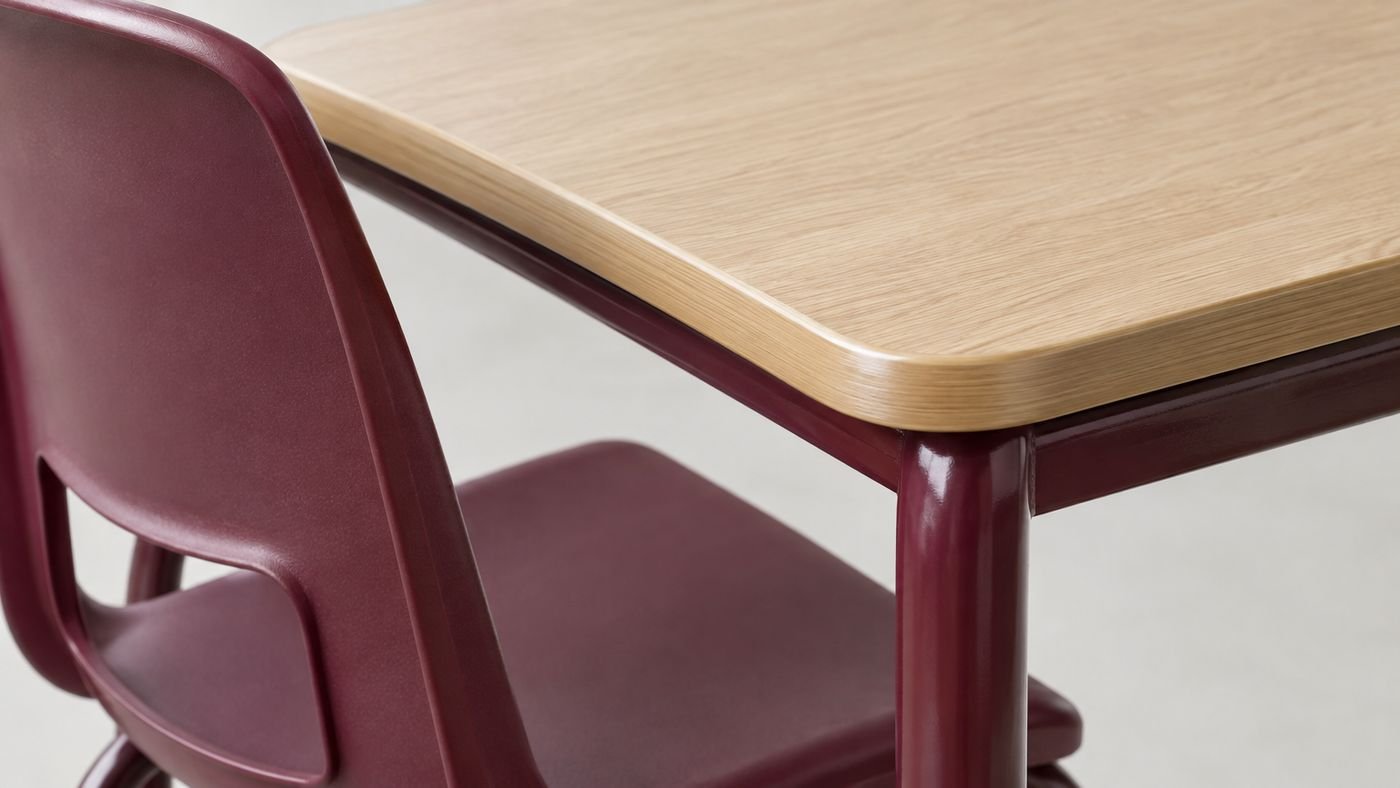
Why It Matters for UAE Schools
Quick answer: Sustainable school furniture lasts a long time, can be repaired rather than thrown away, is made from materials with low chemical emissions and responsible sources, and ideally travels a short distance to the school. For UAE schools it also supports green school accreditation under the national Green Education Partnership.
Sustainability is now part of how UAE schools are run. The Ministry of Education’s Green Education Partnership works across four pillars, including Greening Schools, and set a target for half of the country’s schools and campuses to become green accredited. Many schools work towards this through programmes such as Eco-Schools, run by the Foundation for Environmental Education.
Furniture is a smaller part of a school’s footprint than energy or water, but it is one of the few areas where a single buying decision has an effect for ten years or more. It also shows students that the school’s sustainability message applies to its own purchases.
What Makes School Furniture Sustainable
| Factor | What to look for |
|---|---|
| Durability | Strong frames, thick tops and good fixings, so furniture survives years of daily use |
| Repairability | Seats, tops, glides and fixings that can be replaced on their own, rather than throwing away the whole item |
| Right size | Furniture sized for the grade, so it is not replaced early because children cannot use it comfortably |
| Low emissions | Boards and finishes with low formaldehyde and VOC emissions for healthy classroom air |
| Responsible materials | Recyclable steel, certified wood (for example FSC) and recyclable plastics |
| Distance travelled | Furniture made closer to the school travels less and is easier to support after delivery |
| End of life | Materials that can be separated and recycled, or furniture that can be reused elsewhere |
School Furniture Materials Compared
| Material | Sustainability strengths | Watch for |
|---|---|---|
| Steel frames | Very long life; steel is widely recycled | Choose a good powder coat so frames do not rust and need replacing |
| Solid wood | Renewable; can be sanded and refinished | Ask for certified sources such as FSC; heavier to move |
| Board with laminate top (MDF, particleboard) | Uses wood fibre efficiently; hard-wearing surface | Ask for the formaldehyde emission class of the board and sealed edges so it does not swell |
| Compact laminate | Extremely durable; resists water and scratches | Higher upfront cost, but often the longest life for tops |
| Polypropylene plastic | Light, durable and recyclable at end of life | Thin shells crack; choose a thick, one-piece shell |
| Upholstery | Comfort in staff and library areas | Stains and wears faster; use wipe-clean or replaceable covers |
Our school furniture materials guide compares tops, frames and seats in more detail.
Indoor Air: Formaldehyde and Emissions
Children spend most of the school day indoors in air-conditioned rooms, so what furniture releases into the air matters. Many wood-based boards are made with formaldehyde-based glues, which can release small amounts of formaldehyde into the room, especially when the furniture is new.
- Ask for the emission class. In Europe, boards classed as E1 must not release more than 0.1 ppm of formaldehyde. Ask suppliers which class, or which equivalent standard, their boards meet.
- Look for sealed edges and surfaces. Laminate tops and edge banding cover the board and reduce emissions.
- Air out new furniture. Where possible, install furniture before the holidays end and ventilate rooms before students return.
- Choose low-VOC finishes for paints and coatings on furniture and storage.
Questions to Ask Suppliers
- Where is the furniture made, and how far does it travel to our school?
- Which parts can be replaced on their own, and are spare parts available in the UAE?
- What is the formaldehyde emission class of the boards used?
- Is any wood certified, for example FSC?
- What are the frames and plastics made of, and can they be recycled?
- What warranty is offered, and what does it cover?
- Can the same model be ordered again in future years, so new and old rooms match?
Ask for answers in writing so you can compare suppliers fairly. If you are buying through a tender, add these points to the specification; see our tender and specification guide.
Making Furniture Last Longer
- Buy the right size first time. Plan chair and desk sizes by grade; see desk height by age.
- Standardise models across the school, so furniture can move between rooms as class sizes change.
- Maintain it. Tighten fixings, replace worn glides and clean with mild products. Our maintenance guide has a simple schedule.
- Repair before replacing. A new seat or top is far cheaper, and less wasteful, than a new chair or desk.
- Reuse old furniture. Furniture that no longer suits one room may suit storage, a staff area or another school.
Thinking about where furniture comes from? Our guide to UAE-made school furniture explains what local manufacturing changes.
How We Help
Madrasati makes school furniture in our own factory in the UAE, so furniture travels a short distance to your school, can be made to the right size for each grade, and the same models can be made again for future top-ups. We provide samples on large orders and deliver and install in all seven emirates. Ask us about materials and specifications for your project.
Sustainable School Furniture Questions
What is sustainable school furniture?
Furniture that lasts a long time, can be repaired rather than replaced, is made from responsibly sourced materials with low chemical emissions, and ideally is made close to the school.
Does furniture count towards green school accreditation in the UAE?
Accreditation programmes focus mainly on energy, water, waste and learning, but responsible purchasing, including long-lasting, low-emission furniture, supports a school’s overall sustainability plan. Check the criteria of the programme your school follows.
What does E1 mean for school furniture?
E1 is a European formaldehyde emission class for wood-based boards. E1 boards must not release more than 0.1 ppm of formaldehyde. Ask suppliers which class or equivalent standard their boards meet.
Is steel or wood more sustainable for school furniture?
Both can be. Steel frames last a very long time and are widely recycled; wood is renewable when it comes from certified sources. Durability usually matters more than the material itself.
Is locally made furniture more sustainable?
Furniture made in the UAE travels a much shorter distance than furniture shipped from overseas, and is easier to support with matching repeat orders over its life.
Sources: UAE Ministry of Education, Green Education Partnership Roadmap (moe.gov.ae); Foundation for Environmental Education, Eco-Schools and the UN Greening Education Partnership; German Environment Agency (UBA), formaldehyde emissions from wood-based materials; E1 emission class (0.1 ppm). General information only; check the criteria of your own accreditation programme.
Planning Furniture With Sustainability in Mind?
Send your room list and any materials requirements. We will quote every line in writing, made in our own factory in the UAE.